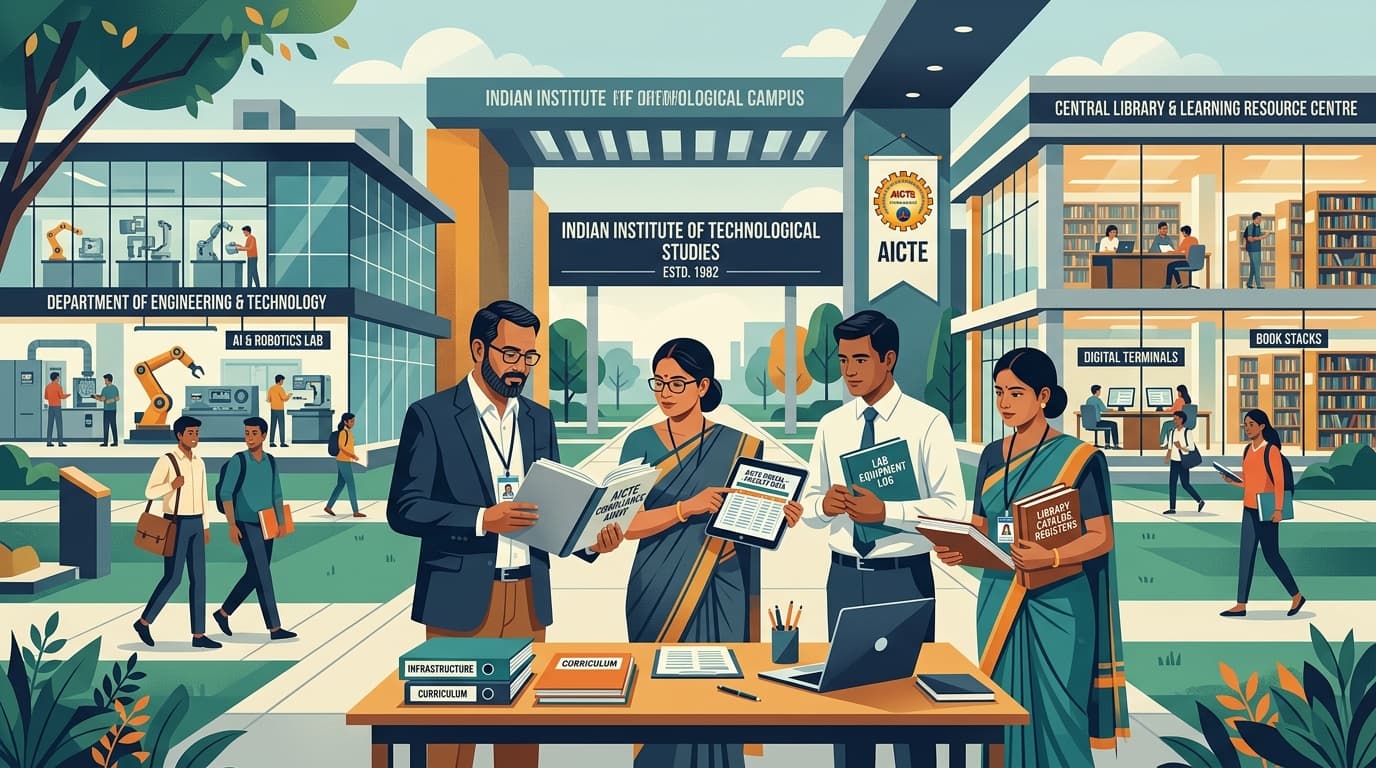
Every year, millions of students seek admission into engineering, management, computer applications, and technical colleges across India. Simultaneously, college administrators, principals, and librarians prepare extensive documentation for statutory compliance. At the center of this ecosystem stands AICTE (All India Council for Technical Education). Yet, widespread confusion persists: What does AICTE actually do? Do private universities need AICTE approval? How does AICTE differ from UGC? What are the strict library and infrastructure norms mandated during inspection? This comprehensive guide demystifies the AICTE framework with authoritative clarity.
1. What is AICTE? (Full Form, Genesis & Legal Mandate)
AICTE stands for the All India Council for Technical Education (अखिल भारतीय तकनीकी शिक्षा परिषद). It is the premier national statutory apex body responsible for the coordinated planning, formulation, and maintenance of norms and standards in technical and management education throughout India.
Functioning under the Department of Higher Education, Ministry of Education (MoE), Government of India, AICTE operates with statutory authority derived directly from the All India Council for Technical Education Act, 1987 (Act No. 52 of 1987) enacted by the Parliament of India.
November 1945
Originally formed to survey national technical education facilities.
AICTE Act 1987
Parliamentary Act No. 52 vested full regulatory and statutory powers.
Ministry of Education
Department of Higher Education, Government of India, New Delhi.
2. Why Was AICTE Created? (Historical Background)
Prior to the 1980s, technical education in India was governed primarily by regional university affiliations and state directorates with fragmented oversight. Rapid industrialization and the boom in private self-financing engineering colleges created an urgent need for standardisation. Unregulated expansion risked substandard infrastructure, untrained faculty, commercialization, and erratic syllabi.
To solve these challenges, Parliament enacted the AICTE Act in 1987 with three central objectives:
- Proper Planned Growth: Ensuring technical institutions are established based on regional industry needs, avoiding geographic imbalances and redundant capacity.
- Standardization of Quality: Enforcing uniform curricula, minimum faculty-student ratios, well-equipped laboratories, and standardized library holdings.
- Preventing Commercial Exploitation: Curtailing unchecked capitation fees, maintaining baseline quality norms, and safeguarding student interests.
3. What Does AICTE Actually Do? (Key Roles & Responsibilities)
AICTE is not merely an approval-granting office; it regulates, promotes, and audits technical education across multiple dimensions:
1 Formulation of Norms & Standards
Prescribes mandatory requirements for built-up infrastructure, land, laboratory equipment, faculty cadre ratios, computer-to-student ratios, and library collections published in its annual Approval Process Handbook (APH).
2 Granting Approvals & Extension of Approval (EoA)
Scrutinizes applications for establishing new technical institutes, introducing new programs/branches, adding intake divisions, and granting annual Extension of Approval (EoA).
3 Inspections & Expert Visiting Committees (EVC)
Deploys Expert Visiting Committees (EVCs) and conducts surprise physical/virtual quality audits to verify whether declared facilities match on-ground reality.
4 Funding, Scholarships & Research Promotion
Disburses research grants (RPS), modernization funds (MODROBS), PG GATE/CEED student scholarships, PMSSS for J&K/Ladakh students, and Faculty Development Programs (ATAL Academy).
4. Which Institutions and Programmes Come Under AICTE?
Under Section 2(g) of the AICTE Act 1987 and the prevailing Approval Process Handbook, "Technical Education" spans specific academic domains. Whether an institution falls under AICTE depends on the combination of Programme Type, Awarding Format (Diploma/Degree), and Institutional Structure:
| Discipline / Program | Applicable Levels | AICTE Regulatory Status |
|---|---|---|
| Engineering & Technology | Diploma, B.Tech/B.E., M.Tech/M.E. | Direct Mandate & Approval |
| Management (MBA / PGDM) | Postgraduate Diploma (PGDM), MBA | Mandatory Approval for PGDM & Affiliated MBA |
| Computer Applications (MCA) | Master of Computer Applications | Mandatory Approval |
| Architecture & Town Planning | B.Arch, M.Arch, B.Plan, M.Plan | Co-regulated with Council of Architecture (CoA) |
| Hotel Management & Catering (HMCT) | Diploma, B.HMCT, M.HMCT | Direct Mandate & Approval |
| Applied Arts, Crafts & Design | B.Des, M.Des, B.F.A., Diploma | Direct Mandate & Approval |
| BBA / BCA Programmes | Undergraduate Management & IT | Brought under AICTE purview from AY 2024-25 |
5. AICTE vs UGC: Understanding the Differences
A frequent point of confusion is the distinction between UGC (University Grants Commission) and AICTE. While both function under the Ministry of Education, their constitutional scopes, legal mechanisms, and institutional targets differ significantly:
| Parameter | UGC (University Grants Commission) | AICTE (All India Council for Technical Education) |
|---|---|---|
| Statutory Act | UGC Act, 1956 | AICTE Act, 1987 |
| Primary Focus | General Higher Education & University Coordination | Technical, Engineering & Management Education |
| Degree Granting Power | Empowers Universities under Section 22(1) | Does NOT award degrees; regulates technical standards & approvals |
| Institutional Coverage | Central, State, Deemed & Private Universities | Technical Colleges, Autonomous Institutes, Polytechnics & PGDM Schools |
| Diploma & PGDM Oversight | Does not regulate standalone diploma/PGDM institutes | Direct statutory regulator for Polytechnics & Standalone PGDM institutes |
| Mandatory Inspection Focus | General academic standards, governance, university rules | Detailed technical infrastructure, labs, computing, library formulas (APH) |
6. Do Universities Need AICTE Approval? ("It Depends" — Legal Nuance)
The question of whether a University requires AICTE approval cannot be answered with a simple "yes" or "no". Indian jurisprudence, led by landmark Supreme Court judgments, establishes a clear constitutional distinction:
1. Universities Created by Act of Parliament or State Legislature
In the landmark Bharathidasan University v. AICTE (2001) judgment, the Supreme Court ruled that a university established under a statute does NOT require prior permission or approval from AICTE to start a technical department or course. The definition of "technical institution" in Section 2(h) of the AICTE Act excludes universities.
2. Norms & Standards Are Still Mandatory
While universities do not need prior institutional approval to begin courses, the Supreme Court clarified in Association of Management of Private Colleges v. AICTE (2013) and subsequent rulings that universities are obligated to adhere to AICTE norms and standards regarding curriculum, teacher qualifications, contact hours, and laboratory/library infrastructure.
3. Affiliated Colleges Under Universities MUST Have AICTE Approval
Unlike the university's own campus departments, all affiliated colleges (whether government, aided, or private self-financing) offering technical courses MUST obtain mandatory annual AICTE approval to admit students.
4. Deemed-to-be Universities & Technical Degrees
Following the Supreme Court's ruling in Orissa Lift Irrigation Corp. Ltd. v. Rabi Sankar Patro (2017), Deemed-to-be Universities offering technical education (especially distance/ODL degrees) are subject to stringent AICTE-UGC joint regulation, and technical qualifications without required approvals are invalid.
7. Is AICTE Approval Compulsory? (Clear Breakdown by Institution Type)
To avoid blanket assumptions, examine where mandatory approval applies:
Approval Is Mandatory
- All Private & Government Engineering Colleges
- All Polytechnic & Diploma Institutes
- Standalone Business Schools offering PGDM/PGCM
- Institutes offering MCA & HMCT programs
- Institutions offering BBA/BCA (from AY 2024-25 onwards)
- Affiliated Technical Institutions seeking University affiliation
Norms Apply (Prior Approval Optional / Regulated by UGC)
- Central University technical departments
- State Public University on-campus engineering faculties
- Private Universities established under State Acts (must follow AICTE norms)
- Institutions of National Importance (IITs, NITs, IISc, IIITs)
8. Why Do Institutions Need to Follow AICTE Guidelines?
Compliance with AICTE guidelines is not merely bureaucratic red tape; it provides legal validity, academic credibility, and structural protection for all stakeholders:
- Legal Recognition of Qualifications: Central and State Government recruiters (UPSC, SSC, PSU undertakings, DRDO, ISRO, Indian Railways) mandate that engineering diplomas, degrees, and PGDM certificates come from AICTE-approved institutions or recognized universities following AICTE norms.
- Mandatory for University Affiliation: State Technical Universities (e.g., AKTU, GTU, VTU, Anna University, MAKAUT) will not grant or renew annual academic affiliation without valid AICTE Extension of Approval (EoA).
- Eligibility for Central Funding & Schemes: AICTE-approved colleges qualify for central research grants, AICTE-ATAL faculty development programs, Pragati/Saksham scholarships, and student exchange initiatives.
- Prerequisite for NBA Accreditation: National Board of Accreditation (NBA) evaluates programs only in institutions with continuous AICTE approval.
- Consequences of Non-Compliance: Failure to comply with norms results in severe penalties, including reduction in approved intake, "No Admission" status, withdrawal of approval, and placement on the public Unapproved Institutions List.
9. Does AICTE Inspect Institutions? (EVC Visits & Institutional Quality Audits)
Yes. AICTE exercises statutory inspection powers under Section 10 and Section 11 of the AICTE Act. Inspections are conducted through specialized expert committees to ensure that on-ground reality matches statutory disclosures:
What AICTE Expert Visiting Committees (EVC) Check During Campus Audits
An AICTE inspection is an exhaustive physical and documentary verification covering nine critical pillars of institutional operation:
Scrutiny & Defect Committees
Reviews institutional self-disclosure portals, digital land records, building plans, and statutory deposits prior to physical visits.
Expert Visiting Committee (EVC)
A team of senior academicians (typically IIT/NIT/University professors) and architects visiting the campus to conduct physical verification of labs, classrooms, faculty rosters, and the library.
Surprise Inspections (SHC)
Unannounced visits initiated upon receiving complaints regarding ghost faculty, deficient labs, inadequate library collections, or non-payment of mandated salaries.
10. AICTE and Libraries: Mandatory Standards Under APH 2024–27
The central library is one of the most rigorously evaluated departments during an AICTE Expert Visiting Committee (EVC) inspection. Under the AICTE Approval Process Handbook 2024-25 to 2026-27 (Annexure-4 & Section 4.2), technical institutions must operate a fully automated, digitally integrated, and well-stocked Central Library.
Comprehensive AICTE Library Resource & Infrastructure Framework
APH 2024–27 NormsPrescribed Book Holdings
Mandatory base titles and volumes per division with an annual augmentation rate of 15% to 20% modern editions across all engineering, management, and technical branches.
6 Print Journals / Division
Minimum 6 physical print journals subscribed per programme/division with active subscription registers, original publisher invoices, and physical display racks.
E-Journals & Databases
Institutional subscriptions to scholarly peer-reviewed full-text e-journals (IEEE, ScienceDirect, Springer, ASCE, ASME, EBSCO, J-Gate) accessible over campus IP/remote login.
Integrated Software & OPAC
Automated Integrated Library Management Software (e.g., KOHA) managing circulation, cataloging with barcode/RFID integration, and live Web OPAC for patrons.
Dedicated Multimedia PCs
Minimum 10% of total computer terminals (max 30 terminals) dedicated to digital library access, research queries, multimedia e-learning, and NPTEL viewing.
NDLI Club & DELNET
Active institutional membership with National Digital Library of India (NDLI Club) and DELNET/e-ShodhSindhu for inter-library loans and institutional repository archives.
Reading Room & Seating
Adequate carpet area accommodating comfortable seating for 15% to 25% of total student & faculty strength, with dedicated faculty study carrels and discussion zones.
Annual Stock Verification
Duly signed annual physical stock verification register, loss write-off committee resolutions under GFR rules, and up-to-date accession registers.
Qualified Cadre & LAC
Full-time College Librarian & Assistant Librarian meeting AICTE cadre norms, backed by regular Library Advisory Committee (LAC) minutes and budget files.
11. 15-Point Practical AICTE Library Compliance Checklist
To ensure 100% readiness for AICTE inspections and annual EoA filings, college librarians and directors should verify these 15 physical and digital compliance checkpoints:
Need to Audit Your Library for AICTE Inspection?
Use the LISWALA AICTE Library Inspection Guide and interactive Audit Report Generator to calculate exact book titles, volumes, print journals, and digital requirements under APH 2024–27.
12. AICTE Approval vs NBA / NAAC Accreditation
Many students and parents mistakenly assume that "Approval" and "Accreditation" are synonyms. They represent two fundamentally different tiers of evaluation:
AICTE Approval (Statutory Minimum)
AICTE approval is the mandatory baseline operating license required to operate a technical institute. It certifies that an institution satisfies minimum requirements regarding land, labs, faculty counts, and library books.
NBA / NAAC Accreditation (Quality Benchmark)
Accreditation is an outcome-based quality benchmark. NBA (National Board of Accreditation) accredits specific technical programmes (Tier-I / Tier-II Washington Accord status), while NAAC accredits the entire institution. Accreditation is voluntary or graded.
13. Common Misconceptions: AICTE Myth vs Fact
"AICTE awards university degrees to students."
AICTE is a regulatory council, not a university. Degrees (B.Tech, MBA, MCA) are awarded exclusively by UGC-recognized universities. AICTE awards approval to institutions offering these degrees or standalone diplomas/PGDM.
"Private Universities are completely exempted from all AICTE norms."
While Private Universities do not need prior permission to establish departments, the Supreme Court has affirmed that they must maintain AICTE-prescribed academic, faculty cadre, and infrastructural standards.
"Every arts, science, and commerce college needs AICTE approval."
Conventional B.A., B.Sc., B.Com, and M.A. colleges come solely under UGC and the affiliating state university. AICTE regulates only technical, engineering, management, architecture, design, and specified vocational courses.
"Print journals can be 100% replaced by YouTube links or free blog posts."
AICTE APH 2024–27 mandates a minimum of 6 physical Print Journals per programme, supported by verified invoices and postal dispatch proof. E-resources must be scholarly peer-reviewed indexed databases.
14. What Should Students and Parents Check Before Taking Admission? (8-Step Checklist)
Before paying fees or accepting an admission offer, students and parents should verify these eight critical parameters:
aicte-india.org) to confirm the college holds a valid EoA for the current academic session.
15. AICTE Applicability Decision Flowchart
Use this quick logical flow to determine whether an institution requires mandatory AICTE approval:
16. Quick Summary: 11 Core Questions Answered
| Question | Short Answer |
|---|---|
| What is AICTE? | National statutory council under MoE regulating technical and management education in India. |
| When was it established? | Formed in 1945 as an advisory body; became a statutory authority in 1987 via the AICTE Act. |
| Does AICTE award degrees? | No. Degrees are awarded by UGC-recognized universities; AICTE approves institutes and programs. |
| Is AICTE approval compulsory for engineering colleges? | Yes. All affiliated colleges and polytechnics require mandatory AICTE approval. |
| Do State Private Universities need AICTE approval? | Prior approval is not mandatory for university degree departments, but AICTE norms must be maintained. |
| Are BBA and BCA under AICTE? | Yes. AICTE brought undergraduate BBA, BMS, and BCA programs under its purview starting AY 2024-25. |
| What is the library journal requirement? | Minimum 6 Print Journals per programme/division plus scholarly e-resources and NDLI membership. |
| What is the digital library requirement? | Minimum 10% of total computer terminals (max 30) dedicated to digital library access. |
| Is library automation mandatory? | Yes. Institutions must deploy automated library software (ILMS) with functional OPAC. |
| What is the difference between Approval and NBA? | Approval is a mandatory minimum baseline license; NBA is an outcome-based quality accreditation. |
| Where can I verify a college's approval? | On the official portal at aicte-india.org under "Approved Institutes". |
17. Official References & Primary Sources
This guide is compiled directly from official statutory acts, judicial precedents, and regulatory handbooks:
- Primary Handbook: AICTE Approval Process Handbook (APH) 2024-25 to 2026-27 (Official PDF)
- Statutory Act: All India Council for Technical Education Act, 1987 (Act No. 52 of 1987), Parliament of India.
- Supreme Court Precedents: Bharathidasan University & Anr. v. AICTE (2001) 8 SCC 676; Association of Management of Private Colleges v. AICTE (2013) 8 SCC 271; Orissa Lift Irrigation Corp. Ltd. v. Rabi Sankar Patro (2017).
- Official Portal: AICTE Official Portal (aicte-india.org)
18. Frequently Asked Questions (FAQs)
Q1: What is the full form of AICTE?
AICTE stands for the All India Council for Technical Education, established by the AICTE Act, 1987.
Q2: Is AICTE approval mandatory for government jobs in India?
Yes. For technical posts (Engineers, Scientists, Managers) in PSUs, Railways, UPSC, SSC, and state governments, diplomas and technical degrees must be from AICTE-approved institutions or recognized universities conforming to AICTE norms.
Q3: Do State Private Universities need separate AICTE approval?
As per Supreme Court rulings, private universities established under State Legislature Acts do not require prior AICTE approval to offer degree programs, but they are mandated to maintain AICTE minimum curriculum, faculty, and laboratory/library norms.
Q4: Are BBA and BCA programs under AICTE now?
Yes. AICTE brought undergraduate programs in Management (BBA, BMS) and Computer Applications (BCA) under its regulatory purview starting academic year 2024-25 to ensure curriculum standardization and industry alignment.
Q5: What is the difference between AICTE and UGC?
UGC coordinates general university education and empowers universities to award degrees under the UGC Act 1956. AICTE specifically regulates technical, engineering, and management programs, establishing infrastructure and curricular standards under the AICTE Act 1987.
Q6: What is an Extension of Approval (EoA)?
An Extension of Approval (EoA) is an annual statutory clearance granted by AICTE to existing technical institutions after reviewing annual compliance disclosures, faculty data, infrastructure, and fee norms.
Q7: How many print journals must a technical college subscribe to according to AICTE?
Under the Approval Process Handbook 2024–27, technical institutions must subscribe to a minimum of 6 Print Journals per programme/division, supported by original publisher invoices, payment vouchers, and postal receipt registers.
Q8: Is library stock verification mandatory every year under AICTE?
Yes. Annual physical stock verification is mandatory. Libraries must maintain a verified Stock Verification Register with committee signatures and documented loss write-off resolutions compliant with General Financial Rules (GFR).
Q9: Can an institution offer PGDM without AICTE approval?
No. Standalone institutions offering Post Graduate Diploma in Management (PGDM) or Post Graduate Certificate in Management (PGCM) must hold mandatory AICTE approval. Unapproved PGDM programs are legally invalid.
Q10: What happens if a college loses AICTE approval?
If AICTE withdraws approval or places an institution on "No Admission" status, the affiliating university cannot conduct examinations for new batches, degrees become invalid for government recruitment, and the college cannot admit new students.
Q11: How do I verify if my engineering college is AICTE approved?
Visit the official AICTE web portal at aicte-india.org, navigate to "Approved Institutes" → "Dashboard", select your state, district, program, and academic year to view the institution's official EoA letter.
Q12: What is the Digital Library requirement under AICTE?
Colleges must maintain dedicated multimedia computer terminals representing at least 10% of total computing capacity (max 30) connected to high-speed internet, with access to e-journals, DELNET, and NDLI club facilities.
Q13: What software tools are available to help librarians prepare for AICTE audits?
LISWALA provides free, specialized library compliance utilities, including the AICTE Library Audit & Report Generator, Stock Verification Tool, and barcode generation utilities.
Final Summary
Navigating AICTE regulations requires distinguishing between statutory baseline mandates (AICTE approval) and voluntary quality benchmarks (NBA/NAAC accreditation). Whether you are a student choosing a technical college or a librarian preparing physical registers and digital library terminals for an upcoming Expert Visiting Committee (EVC), maintaining compliance with the official Approval Process Handbook 2024-25 to 2026-27 guarantees academic excellence and institutional legitimacy.
Looking for LISWALA Tool Tutorials?
Explore step-by-step guides on how to use LISWALA tools for barcode generation, no-dues verification, and MARC21 conversion.