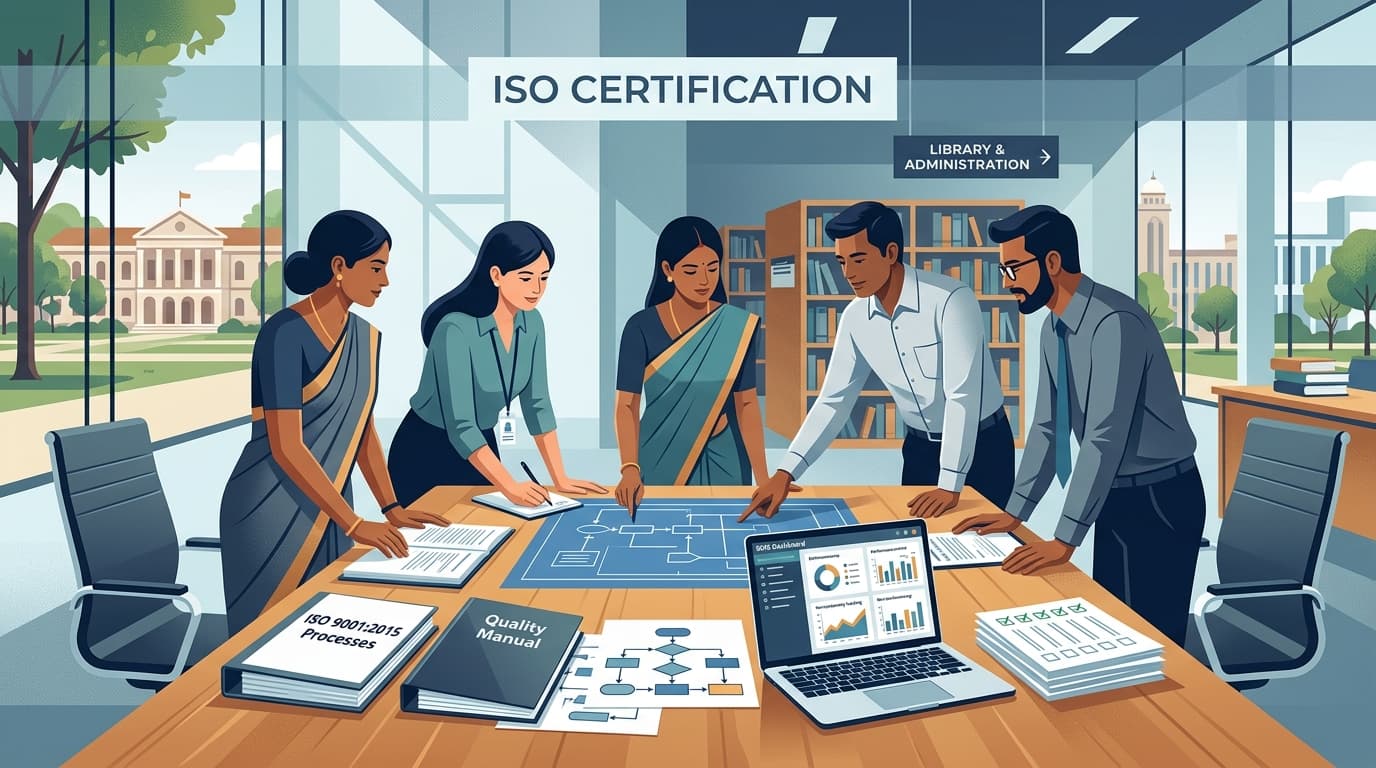
In today's competitive academic landscape, higher education institutions, colleges, universities, and specialized libraries frequently display designations such as "ISO 9001:2015 Certified" or "ISO 21001:2018 Certified". Yet, widespread confusion exists across academic leadership, faculty, and library staff: What does ISO actually stand for? Does ISO itself issue certificates? Is ISO certification compulsory for colleges and universities? How does it differ from NAAC or AICTE accreditation? And how does an academic library implement ISO standards to streamline operational excellence? This comprehensive guide demystifies the entire ISO ecosystem with authoritative clarity.
1. What is ISO? (Full Form, Genesis & Role)
ISO stands for the International Organization for Standardization (अंतर्राष्ट्रीय मानकीकरण संगठन). Headquartered in Geneva, Switzerland, ISO is an independent, non-governmental international organization founded on February 23, 1947. It brings together national standards bodies from over 170 member countries (including the Bureau of Indian Standards — BIS in India, ANSI in the United States, and BSI in the United Kingdom).
ISO's primary mission is to develop and publish voluntary, consensus-based, market-relevant International Standards that ensure the quality, safety, security, interoperability, and efficiency of products, services, and management systems worldwide.
23 February 1947
Founded in Geneva, Switzerland to harmonize global standards.
170+ Member Nations
Represented in India by the Bureau of Indian Standards (BIS).
25,000+ Standards
Covering technology, management, safety, education & libraries.
2. What is ISO Certification?
ISO Certification is a formal confirmation issued by an independent, third-party certification body (Registrar) certifying that an organization's management system, process, service, or documentation complies with all the requirements of a specific ISO standard within a clearly defined scope.
To understand how certification functions in practice, consider the three-tier hierarchy:
ISO (Standards Body)
Develops and publishes international standards (e.g., ISO 9001, ISO 21001). ISO does not issue certificates.
Certification Body (CB)
Independent audit firm (accredited by bodies like NABCB / UKAS / ANAB) that audits the institution and issues the certificate.
The Institution
Implements the standard's policies, SOPs, workflows, and risk controls across university departments and libraries.
3. ISO Standard vs ISO Certification
It is vital to distinguish between the standard itself and the certification awarded against it:
| ISO Standard | ISO Certification |
|---|---|
| Defines established international requirements, guidelines, or best practices. | Demonstrates that an organization conforms to those requirements via third-party audit. |
| Authored and published by ISO technical committees. | Issued by an independent accredited certification body (Registrar). |
| Can be adopted internally as a continuous improvement framework without external certification. | Requires formal Stage-1 and Stage-2 external audits, surveillance audits, and periodic reassessments. |
| Some standards provide guidelines only (e.g., ISO 31000, ISO 2789 for library statistics). | Applies only to management system standards designed for certification (e.g., ISO 9001, ISO 21001, ISO 27001). |
4. Who Develops ISO Standards?
ISO standards are developed through a collaborative, consensus-driven process managed by **ISO Technical Committees (TCs)**, subcommittees, and working groups. These committees comprise global subject-matter experts, industry practitioners, academic scholars, government representatives, testing laboratories, and consumer groups nominated by national standards institutes (such as BIS in India).
The standard creation cycle follows a rigorous multi-stage procedure:
- Proposal Stage: Identification of a global market or sector need.
- Preparatory & Committee Stage: Drafting of the International Standard by technical experts.
- Enquiry & Approval Stage: Circulated to all 170+ member bodies for voting and technical review.
- Publication & Systematic Review: Published upon reaching 75% consensus and reviewed every 5 years to maintain technological and operational relevance.
5. Who Provides ISO Certification? (ISO vs AB vs CB)
A common misconception in academia is that certificates are issued directly by ISO in Geneva. In reality, certification operates through an internationally recognized **conformity assessment ecosystem**:
International Accreditation Forum (IAF) & Regional Bodies
The global association of conformity assessment accreditation bodies that ensures mutual recognition of certificates across borders through Multilateral Recognition Arrangements (MLA).
National Accreditation Bodies (AB)
Authoritative national bodies that assess and accredit certification bodies for technical competence. In India, this is the National Accreditation Board for Certification Bodies (NABCB) under the Quality Council of India (QCI). In the UK, it is UKAS; in the US, ANAB.
Accredited Certification Bodies (CB / Registrar)
Independent commercial or non-commercial audit organizations accredited by an AB to audit universities, colleges, or libraries against ISO standards and issue the ISO certificate.
6. Common Types of ISO Standards in Higher Education
While ISO has published over 25,000 standards, five management system standards are particularly prominent within colleges, universities, and research institutions:
ISO 9001:2015 — Quality Management Systems (QMS)
Most Widely AdoptedThe global benchmark for quality management based on the Plan-Do-Check-Act (PDCA) cycle and risk-based thinking. In colleges and libraries, ISO 9001 focuses on standardizing administrative workflows, admissions, examination administration, library cataloguing, student support services, and institutional continuous improvement.
ISO 21001:2018 — Educational Organizations Management Systems (EOMS)
Education-SpecificSpecifically designed for educational institutions (from pre-schools to universities and vocational centers). Unlike generic QMS, ISO 21001 focuses directly on learner needs, inclusive education, special educational needs (Divyangjan/SEN support), ethical conduct, learner well-being, and curriculum delivery effectiveness.
ISO/IEC 27001:2022 — Information Security Management Systems (ISMS)
Data & Cyber SecurityProvides a systematic framework for managing sensitive institutional information, ensuring confidentiality, integrity, and availability (CIA triad). In educational institutions and libraries, it safeguards student personal records, examination databases, ERP credentials, digital repository assets, and e-resource subscription access.
ISO 14001:2015 — Environmental Management Systems (EMS)
Green CampusEstablishes requirements for managing institutional environmental responsibilities. Helps universities implement sustainable campus initiatives, solar energy utilization, rainwater harvesting, e-waste management, paperless library initiatives, and carbon footprint reduction.
ISO 45001:2018 — Occupational Health & Safety Management (OH&SMS)
Campus SafetyFocuses on creating safe, healthy environments for students, faculty, staff, and laboratory personnel. Addresses fire safety in libraries and laboratories, ergonomic furniture in reading rooms, emergency evacuations, and hazardous chemical handling.
7. Other Relevant ISO Standards & Guidance Frameworks
Beyond the primary certification standards, several other standards provide specialized guidance for university and library operations:
ISO 50001:2018 (Energy Management)
Framework for energy efficiency in large university campus buildings, air conditioning, and data centers.
ISO 22301:2019 (Business Continuity)
Ensures critical academic, examination, and digital library services continue during natural disasters or disruptions.
ISO 31000:2018 (Risk Management Guidance)
Provides principles and generic guidelines on institutional risk management (guidance standard, not for certification).
ISO 11620 & ISO 2789 (Library Metrics)
International standards for library performance indicators and statistical data collection methodology.
8. Which ISO Standards are Relevant to Educational Institutions?
The table below provides a quick reference to evaluate the potential relevance of each standard to your institution:
| ISO Standard | Core Focus | Potential Relevance to Educational Institutions |
|---|---|---|
| ISO 9001 | Quality Management (QMS) | Institution-wide process consistency, admissions, admin, examinations & library services. |
| ISO 21001 | Educational Organizations (EOMS) | Dedicated standard for teaching, learning outcomes, inclusive education & student satisfaction. |
| ISO/IEC 27001 | Information Security (ISMS) | Cybersecurity, student data privacy, LMS integrity, digital library repositories & ERP security. |
| ISO 14001 | Environmental Management (EMS) | Green campus initiatives, solar energy, waste segregation, rainwater harvesting & eco-friendly audits. |
| ISO 45001 | Occupational Health & Safety | Campus health & safety, laboratory hazard prevention, ergonomic reading halls & emergency exits. |
| ISO 50001 | Energy Management | Campus-wide energy optimization, carbon reduction & smart building resource management. |
| ISO 22301 | Business Continuity | Continuity of exams, classes, online portals, and digital library services during emergencies. |
9. Is ISO Certification Compulsory for Universities and Colleges?
Whether an educational institution pursues ISO certification depends on several strategic and contextual factors:
- Institutional Quality Policy: Universities adopting voluntary quality benchmarks to build a strong culture of internal quality assurance (IQAC).
- State Government Directives / Quality Missions: Certain state higher education departments or technical boards encourage or mandate government colleges to achieve ISO 9001 or ISO 21001 certification.
- Government Tenders & Research Grants: Some public and corporate funding bodies require bidders or partner institutions to possess valid ISO 9001/ISO 27001 certification.
- NAAC & NIRF Documentation: ISO certification processes establish documented SOPs, feedback mechanisms, and internal audits that directly support NAAC Criterion 6 (Governance, Leadership & Management) and Criterion 4 (Infrastructure & Learning Resources).
10. Why Do Educational Institutions Get ISO Certification? (Key Benefits)
When implemented with genuine institutional commitment rather than mere paper compliance, ISO standards yield substantial transformative benefits:
1. Process Standardization
Transforms informal practices into well-documented Standard Operating Procedures (SOPs), reducing service variations across departments.
2. Documented Accountability
Clearly defines job roles, responsibilities, reporting hierarchies, and approval authorities for faculty, staff, and librarians.
3. Proactive Risk Management
Identifies potential academic, operational, infrastructural, and cyber risks before they escalate into critical failures.
4. Continuous Improvement (CI)
Embeds the Plan-Do-Check-Act (PDCA) cycle into institutional DNA, preventing stagnation and fostering innovation.
5. Data-Driven Monitoring
Establishes Key Performance Indicators (KPIs) for course completion, library footfall, circulation rate, and grievance turnaround.
6. Enhanced Stakeholder Trust
Demonstrates to students, parents, recruiters, and regulatory agencies that the institution operates under verifiable global standards.
11. Scope Matters: Understanding Institutional Certification Scope
Every ISO certificate includes an explicit Scope of Certification statement. It is crucial to understand that:
Example Scope A (Full Campus): "Design, delivery of undergraduate and postgraduate academic programs, conduct of examinations, library learning resources, and student support services."
Example Scope B (Departmental / Library): "Provision of library information services, acquisition, cataloguing, e-resource management, and user reference services."
If only a specific department or library is audited, the certificate applies solely to that defined scope, not automatically to the entire university. Transparent declaration of the scope is an essential ethical and compliance requirement.
12. ISO Certification and the Academic Library (A Librarian's Perspective)
The university library is the intellectual nerve center of an educational institution. Under an ISO management system (such as ISO 9001:2015 or ISO 21001:2018), the library transitions from subjective routines to a structured, metrics-driven service model.
1. Core Library Process Standardization
- Acquisition & Book Selection: Documented workflow for department indent verification, discount negotiation, and accessioning.
- Cataloguing & Classification: SOPs for MARC21, DDC, and metadata entry accuracy in ILMS (Koha/SLIM/Libsys).
- Circulation Management: Transparent rules for issue, return, renewal, overdue fine calculation, and lost book recovery.
- Serials & E-Resources: Structured renewal calendar, IP authentication, remote access (EZproxy/MyLOFT), and usage statistics.
2. Library Quality & Service Indicators
- User Satisfaction Feedback: Biannual structured surveys evaluating collection adequacy, digital access, and staff courtesy.
- Grievance Redressal: Documented patron complaint log with defined resolution timeframes (e.g., 48 hours).
- Stock Verification Records: Annual physical stock verification SOP, reconciliation registers, and write-off approval files.
- Library Committee (LAC) Minutes: Documented records of budget allocations, policy revisions, and subscription approvals.
3. Information Security in Libraries (ISO 27001)
- Patron Privacy: Confidentiality of borrowing records, student RFID data, and OPAC user credentials.
- Digital Repository Security: Access control, institutional repository (DSpace/EPrints) backups, and thesis embargo protocols.
- Database License Compliance: Prevention of bulk automated scraping or unauthorized off-campus credentials sharing.
4. Risk Management in Libraries (ISO 31000)
- Disaster Preparedness: Fire safety extinguishers, water leakage mitigation, pest control, and emergency exits.
- Server & Cloud Continuity: Daily automated database backups of the ILMS/Koha server to prevent catalog data loss.
- Vendor Risk Management: Contingency planning for delayed book deliveries or journal subscription discontinuation.
13. The ISO Certification Process: Step-by-Step Roadmap
Achieving ISO certification is a structured journey consisting of 11 sequential milestones:
Institutional ISO Certification Flowchart
14. What is a Gap Analysis?
A Gap Analysis is the foundational preliminary assessment where the institution compares its current operational practices against the mandatory clauses of the chosen ISO standard. The identified differences represent the "gaps" that must be bridged before facing the certification auditor.
| Area / Library Function | Current Informal Practice | ISO Management System Requirement |
|---|---|---|
| User Complaints | Oral complaints received at circulation desk with no tracking. | Documented complaint log, root-cause analysis, and corrective action closure within 48 hours. |
| Stock Verification | Irregular physical verification conducted without structured reports. | Approved annual stock verification SOP, missing book reconciliation ledgers, and LAC approval. |
| Database Backup | Occasional manual backup saved to local staff computer. | Automated encrypted daily cloud backup with quarterly restoration drill records. |
15. What Documents May Be Required?
Modern ISO standards (following the Annex SL High-Level Structure) use the term "Documented Information". Documentation varies depending on the institutional scope, but typically includes:
Maintained Information (Policies & SOPs)
- Quality Policy & Institutional Objectives
- Scope Statement with documented exclusions (if any)
- Standard Operating Procedures (SOPs) for all departments
- Process Interaction Flowcharts
- Risk Assessment & Mitigation Matrix
Retained Information (Records & Evidence)
- Staff Training & Competence Records
- Equipment & Server Calibration/Maintenance Logs
- Internal Audit Reports & Nonconformity Logs
- Management Review Meeting (MRM) Minutes
- User Feedback Analysis & Corrective Action Records
16. ISO Audit: What Does an Auditor Look For?
External certification auditors do not simply review printed binders; they verify that the system is actively functioning in daily operations. Auditors operate on the fundamental quality maxim:
Auditors collect objective evidence through three complementary methods:
- Staff Interviews: Asking staff and librarians how they execute tasks and handle irregularities.
- Direct Observation: Observing the circulation desk, reference desk, server room, and safety measures.
- Sample Record Verification: Pulling random accession numbers, purchase orders, leave records, or backup logs to verify compliance.
17. What is a Nonconformity in an ISO Audit?
A Nonconformity (NC) occurs when an audit finding reveals that a specific requirement of the ISO standard, institutional SOP, or regulatory norm has not been fulfilled.
Minor Nonconformity
An isolated lapse that does not break the management system (e.g., a missing training log or delayed review date).
Major Nonconformity
Total absence of a required process or systemic failure (e.g., no internal audits conducted or complete lack of risk assessment).
Opportunity for Improvement
A positive suggestion by the auditor to enhance efficiency; does not block certification.
When an NC is raised, the institution must perform Corrective and Preventive Action (CAPA): identify the root cause (e.g., via the 5-Whys method), implement corrective measures, and submit proof to the certification body within the agreed timeframe.
18. ISO Certification vs Accreditation (Crucial Distinction)
The words "certification" and "accreditation" are often used interchangeably in everyday conversation, but in quality governance they mean two fundamentally different things:
| Parameter | Certification | Accreditation |
|---|---|---|
| Definition | Third-party attestation that an organization's management system conforms to specified standards. | Third-party attestation of the formal competence and authority of a conformity assessment body. |
| Who Evaluates Whom? | A Certification Body (CB) audits a College, University, or Library. | An Accreditation Body (e.g., NABCB, UKAS) audits the Certification Body (CB). |
| Applicable Standard | ISO 9001, ISO 21001, ISO 27001, ISO 14001, ISO 45001. | ISO/IEC 17021 (for CBs), ISO/IEC 17025 (for Testing & Calibration Labs). |
| Key Takeaway | Colleges receive ISO Certification. | Audit firms receive Accreditation to certify colleges. |
19. Comparative Analysis: ISO vs NAAC vs AICTE
Higher education leaders must clearly recognize the distinct roles played by ISO, NAAC, and AICTE:
| Feature | ISO Certification | NAAC Accreditation | AICTE Approval |
|---|---|---|---|
| Nature | Voluntary Management System Standard | National Institutional Quality Accreditation | Statutory Regulatory Approval |
| Authority | Accredited Certification Bodies (CBs) | NAAC (Autonomous UGC Body) | AICTE (Ministry of Education, GoI) |
| Primary Focus | Process consistency, risk management & SOP compliance. | Academic excellence, research output, teaching & infrastructure. | Mandatory minimum infrastructure, faculty norms & intake approvals. |
| Outcome | Certificate of Conformity (Pass / Scope) | Institutional Grade (e.g., A++, A+, A or Binary) | Letter of Approval (LoA / EOA) |
| Mutual Impact | Does not replace NAAC or AICTE. | Evaluates IQAC systems (strengthened by ISO). | Mandatory for technical programmes. |
20. Common Misconceptions (Myth vs. Fact)
21. Practical ISO Preparation Checklist for Educational Institutions
Use this 18-point institutional readiness checklist when preparing for an ISO 9001 or ISO 21001 certification audit:
22. Practical ISO Preparation Checklist for Academic Libraries
Academic librarians should ensure the following documentation and operational records are prepared and maintained:
23. How to Choose an ISO Certification Body (Avoiding "Paper Mills")
To ensure the certificate holds genuine academic and legal credibility, institutions must rigorously evaluate potential Certification Bodies:
1. Check National Accreditation
Ensure the certification body is accredited by a recognized National Accreditation Body such as NABCB (India), UKAS (UK), or ANAB (USA).
2. Verify IAF MLA Membership
Check if the accreditation body belongs to the International Accreditation Forum (IAF) Multilateral Recognition Arrangement (MLA) so the certificate is internationally accepted.
3. Higher Education Competence
Choose certification bodies with experienced auditors who understand academic processes, semester cycles, and university library operations.
4. Avoid Fraudulent "Instant" Certificates
Beware of unaccredited agencies offering instant "certificates in 24 hours without audits". Such certificates carry zero credibility during NAAC or government scrutiny.
24. How Long Does Certification Take and How Much Does It Cost?
There is no single fixed timeline or fee for ISO certification. Key variables determine the duration and budget:
Timeline Variables
- Current Maturity: Institutions with active IQAC and SOPs achieve readiness in 3 to 6 months; fresh setups take 6 to 12 months.
- Institutional Scope: Departmental or library certifications are faster than multi-campus university implementations.
- Auditor Availability: Stage-1 and Stage-2 audit scheduling windows.
Cost Variables
- Auditor Mandays: Determined strictly by accreditation rules based on total staff headcount and number of sites.
- Certification Standard: Single standard vs integrated management system (e.g., ISO 9001 + ISO 21001 + ISO 27001).
- Surveillance Audits: Annual surveillance fees across the 3-year certification cycle.
25. Who Should Be Involved in ISO Implementation?
ISO implementation is an institutional transformation that requires active, collaborative participation across leadership, academic faculties, and support departments:
Top Leadership & IQAC
Vice-Chancellor, Registrar, IQAC Director, and Deans provide resource allocation and strategic direction.
Academic Library Team
University Librarian, Assistant Librarians, and technical staff standardize procurement, cataloguing, and e-access SOPs.
Administrative & Support Wings
Examinations, Admissions, HR, IT, Finance, and Facilities manage records, security, and physical infrastructure.
26. Useful LISWALA Tools for Library Professionals
LISWALA provides modern, free digital utilities designed to assist librarians in maintaining compliance, streamlining daily workflows, and generating audit-ready documentation:
Stock Verification Tool
Automated accession barcode scanning, missing book ledgers & audit reconciliation reports.
Library Inspection Guide
Complete compliance calculators and documentation checklists for AICTE, NAAC & UGC audits.
Excel to MARC21 Converter
Convert spreadsheet catalog data into standardized MARC21 records for Koha and modern ILMS.
Barcode Generator
Generate high-density Code 128 / Code 39 accession barcodes for book spines and member cards.
Spine Label Maker
Create customized DDC classification call-number labels for stack organization.
Library Fine Calculator
Calculate overdue fines across student/faculty categories with exclusion rules for holidays.
27. Official Sources & Citations
The information presented in this guide is derived directly from authoritative international and national standards bodies:
28. Frequently Asked Questions (FAQs)
Q1: What is ISO certification?
ISO certification is a formal written attestation by an independent, accredited certification body confirming that an organization's management system adheres to the requirements of a specific ISO standard within a defined scope.
Q2: What does ISO stand for?
ISO stands for the International Organization for Standardization. The name is derived from the Greek word 'isos', meaning equal.
Q3: Who develops ISO standards?
ISO standards are developed through global consensus by ISO Technical Committees comprising subject matter experts, academic scholars, industry professionals, and national standards institutes from 170+ member nations.
Q4: Who issues ISO certificates?
Certificates are issued by independent third-party **Certification Bodies (Registrars)** that are accredited by national accreditation bodies (such as NABCB in India, UKAS in the UK, or ANAB in the USA). ISO itself does not issue certificates.
Q5: Is ISO certification compulsory for universities in India?
No. ISO certification is voluntary under Indian statutory law. However, institutions adopt it to enhance quality management, strengthen IQAC documentation for NAAC, or satisfy specific state government directives and tender eligibility criteria.
Q6: Which ISO standards are most common in educational institutions?
The most common standards in higher education are **ISO 9001** (Quality Management), **ISO 21001** (Educational Organizations Management), **ISO/IEC 27001** (Information Security), **ISO 14001** (Environmental Management), and **ISO 45001** (Occupational Health & Safety).
Q7: What is ISO 9001?
ISO 9001 is the international standard for Quality Management Systems (QMS). It provides a process-driven framework based on the Plan-Do-Check-Act (PDCA) cycle to ensure consistency, customer/student satisfaction, and continuous improvement.
Q8: What is ISO 21001?
ISO 21001 is a specialized standard tailored for Educational Organizations Management Systems (EOMS). It focuses specifically on learner satisfaction, inclusive education, special educational needs (SEN), and ethical educational delivery.
Q9: What is the ISO certification process?
The process involves: Standard selection $ ightarrow$ Scope definition $ ightarrow$ Gap analysis $ ightarrow$ System development $ ightarrow$ Implementation $ ightarrow$ Internal audit $ ightarrow$ Management review $ ightarrow$ Stage-1 & Stage-2 certification audits $ ightarrow$ Corrective action $ ightarrow$ Certification grant $ ightarrow$ Annual surveillance audits.
Q10: What happens during an ISO audit?
An external auditor reviews documented SOPs, interviews staff, inspects facilities (classrooms, labs, libraries, server rooms), and verifies random records to ensure actual operations comply with the chosen ISO standard.
Q11: What is the difference between ISO certification and accreditation?
Certification is the assessment of an institution's management system by a certification body. Accreditation is the formal verification of the certification body's technical competence by a national accreditation authority (e.g., NABCB).
Q12: What is the difference between ISO and NAAC?
ISO is an international management system standard focusing on process consistency. NAAC is an autonomous national body of the UGC that evaluates overall higher education quality, curriculum, research output, and institutional infrastructure.
Q13: What is the difference between ISO and AICTE?
AICTE is a statutory regulatory council under the Ministry of Education that grants mandatory approvals for technical and management courses. ISO is a voluntary management framework. ISO does not substitute for AICTE approval.
Q14: Can an academic library obtain or operate under an ISO-certified system?
Yes. The library can be included within the university's institutional certification scope or obtain standalone certification for its information management, acquisition, cataloguing, and user reference workflows.
Q15: How long does ISO certification take?
Typically between 3 to 9 months depending on the institution's existing process maturity, size, scope, number of departments, and internal documentation readiness.
Q16: How much does ISO certification cost?
Costs vary depending on the standard, total student/staff headcount, number of campuses, auditor mandays mandated by accreditation guidelines, and 3-year surveillance audit schedules.
Final Summary & Key Takeaways
ISO certification represents a powerful, structured mechanism for colleges, universities, and academic libraries to transition from ad-hoc management to a globally benchmarked, process-driven culture. For educational institutions, standards such as ISO 9001 and ISO 21001 establish rigorous operational frameworks for quality delivery, while ISO/IEC 27001, ISO 14001, and ISO 45001 safeguard digital information assets, green campus initiatives, and occupational safety.
While ISO certification is voluntary and does not replace statutory regulatory approvals (such as AICTE) or national quality accreditations (such as NAAC), it acts as an invaluable catalyst. For academic librarians, embracing ISO principles ensures transparent acquisition workflows, robust cataloguing standards, proactive risk management, and exemplary user-centric services.